4G Body Worn Camera Uses, Scenarios, and Recommendations
4G Body Worn Camera General Overview:
The 4G body worn camera is an intelligent wearable police terminal that integrates high-definition video recording, voice intercom, GPS/BeiDou real-time positioning, and 4G wireless network transmission. It can not only record video for evidence locally, but its core value lies in transmitting the scene back to the command center in real time via 4G network, enabling remote visual dispatch.
4G Body Camera Primary uses:
On-site audio and video evidence collection: High-definition recording of the entire incident, restoring the true situation at the scene, and providing key legal evidence for subsequent determination of responsibility and solving of the case.
Remote visual command and dispatch: The on-site video is pulled up to the back-end in real time, and the command center can conduct remote analysis based on the audio and video from the front and quickly allocate police forces.
Location tracking and trajectory query: Based on the built-in GPS/BeiDou system, personnel coordinates are reported in real time, which makes it easy for the command center to intuitively grasp the distribution of police force on the GIS map.
Public network trunking intercom (PoC): Supports one-click calling (PTT), enabling real-time two-way voice communication between front-line personnel and the back-end, or between team members, without distance limitations.
Standardizing law enforcement and preventing disputes: Full-process record keeping can effectively restrain violations, deter illegal activities, and protect the legitimate rights and interests of law enforcement personnel when faced with false complaints.
AI intelligent analysis: Some high-end models support facial recognition and license plate recognition, and can automatically check against the database during mobile patrols to identify high-risk individuals and vehicles violating traffic rules.
4G Body Worn Camera Applicable Scenarios:
1. Public Security Law Enforcement and Public Safety:
• Routine patrol duty: Police officers carry this on their person while patrolling the streets and handling police incidents to record details of the incident and deter criminals.
• Traffic violation investigation: Traffic police collect evidence on-site when investigating traffic violations or handling traffic accidents on roads and highways.
• Security for large-scale events: crowd control and security maintenance at holidays, sports meets or concerts. The command center can coordinate the overall situation through the transmission of video feeds.
2. Urban Management and Comprehensive Administrative Law Enforcement:
• Urban management law enforcement: For scenarios where verbal or physical conflicts are likely to occur, such as street vending and the demolition of illegal buildings, video recording can reduce law enforcement disputes.
• Market compliance supervision: When market supervision departments inspect restaurant hygiene, cold chain food traceability, and investigate and deal with counterfeit and substandard products, they directly take pictures and upload rectification orders in real time.
• Health and medical supervision: Supervise the compliance of diagnosis and treatment at designated medical institutions, record key processes, and prevent and resolve medical disputes.
3. Emergency Rescue and Safety Supervision:
• Emergency Response: At the scene of incidents such as fires, floods, or earthquakes, the immediate transmission of visual data enables command centers to optimize rescue strategies.
• Corporate Hazard Inspection: Safety inspectors conducting on-site checks at mines or facilities handling hazardous chemicals can transmit real-time footage of critical hazards, helping to prevent safety lapses.
4. Commercial Security and Property Management:
• Security for the park and shopping mall: nighttime security patrols (such as underground parking garages and fire exits), and on-site mediation in cases of vehicle collisions and loss of customer property.
• Visitor registration: Facial snapshots or identity verification are taken during registration at the gate.
Top 4G Body Camera Recommendations
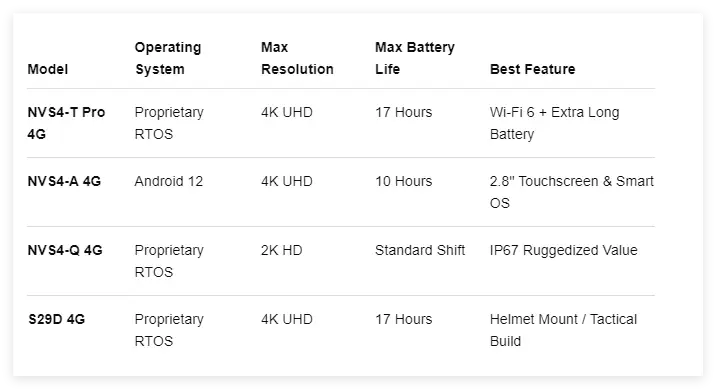
NOVETOM NVS4-T Pro 4G:
• Best for long-shift operations requiring maximum battery efficiency.
• Captures up to 4K Ultra HD video.
• Features a high-capacity battery delivering up to 17 hours of continuous recording at 1080p.
• Built with Wi-Fi 6 connectivity alongside 4G LTE for faster data offloading at the station.
• Includes standard security protocols like AES256 encryption to protect against video tampering.
NOVESTOM NVS4-A body worn camera 4G Android:
• Best for advanced integrations, smart apps, or modern touch interfaces.
• Operates on an Android 12 operating system powered by an 8-core CPU.
• Equipped with a 2.8-inch capacitive multi-touchscreen for easy playback and settings adjustments.
• Features EIS (Electronic Image Stabilization) to keep video feeds smooth during foot pursuits or high-movement situations.
• Native compatibility with both RTMP and RTSP protocols.
NOVESTOM NVS4-Q 4G body worn camera:
• Best mid-range option for standard security patrols.
• Records in Full HD 2K resolution.
• Comes with a rugged IP67 waterproof housing suitable for heavy rain and harsh outdoor elements.
• Standard 4G Nano SIM slot for streaming real-time video directly to dispatchers using the CMSV Platform.
NOVESTOM S29D 4G Tactical Helmet Camera:
• Best for tactical units, military operations, or motorcycle police.
• Specifically designed for helmet-mounted installation instead of vest mounting.
• Offers up to 4K video recording and a high-capacity 4400mAh battery for up to 17 hours of life.
• Includes a Bluetooth trigger option for hands-free or remote recording activation.
Comparison of Key Features: